

 Product Overview
  Enterprise Package
  Integrations
  Security
  Hardware
  FAQ
FAQ 
 How Evocon Works
  OEE Monitoring
  Downtime Tracking
  Manufacturing Data Collection
  Production Monitoring
  Continuous Improvement
  Quality Control
 Learn
Learn  Case Studies
  Reports and Tools
  OEE Fundamentals
  Increasing Productivity
  Sustainability in Manufacturing
 The 5-Day Guide to Launch OEE Monitoring in 2026
 OEE Calculator
  ROI Calculator
  OEE Excel Template
  Evocon
  Contact
  Join us
  Sign in
 Back to main menu
OEE (Overall Equipment Effectiveness) is a standard metric for measuring manufacturing productivity, but its application varies depending on your production environment. Most OEE models were originally designed for discrete manufacturing – making countable items like cars or furniture. If you apply those same models to process-based production without adjustment, the data is often misleading.
This article explains how to adapt OEE for process batch manufacturing, where production is driven by recipes, formulas, and intermittent runs. We will look at how to define this environment, the specific challenges it creates for OEE, and how to use Evocon’s time-based monitoring to get accurate performance data.
Understanding the Context: Process Batch Manufacturing
First, let’s categorize operation types based on what you produce and how you produce it. Manufacturing is generally divided into two primary categories, discrete and process manufacturing, and two operational flows.
1. Primary Categories (What you make)
- Discrete Manufacturing
You produce distinct, countable units. These are typically assembled from components and can often be disassembled. Examples include appliances, electronics, and furniture. - Process Manufacturing
You produce goods in bulk using formulas or recipes. This involves a chemical or physical transformation, such as blending, heating, or cooling. Once the product is made, it cannot be easily disassembled. Examples include food, beverages, chemicals, and pharmaceuticals.
2. Operational Flow (How you make it)
- Continuous Flow
Production runs continuously, without stopping. The equipment is dedicated to one product type for long periods. - Batch Flow
Products are made in specific groups or “lots.” The process is intermittent, meaning the line stops between batches for tasks like cleaning, setup, or changing ingredients.
Batch Manufacturing: Discrete vs. Process
In this article, we focus on the “batch flow” type, but we also need to distinguish how it differs for the two primary categories: batch flow in discrete manufacturing vs. batch flow in process manufacturing.
- The Discrete Batch Case
In discrete manufacturing, batching means producing a set quantity of identical parts before switching the machine setup for a different product. For example, a machine shop might produce a “run” of 500 custom bolts before changing the tools to produce 500 brackets.
When measuring OEE, you still count individual pieces. The primary OEE challenge is the stops during the setup and tool changes between these runs — the Availability loss.
- The Process Batch Case
In process manufacturing, a batch is a specific quantity of material created in a controlled run — like a tank of shampoo or paint.
For OEE measurement, you cannot count “pieces” during the mixing or heating phase. Instead, you measure the time it takes to complete the recipe steps. The primary OEE challenge is Performance loss — when a process step takes longer than intended.
In a Process Batch environment, which we focus on in this article, you are managing bulk formulas in intermittent runs. Because you deal with variables like recipe-dependent speeds and mandatory cleaning (CIP) between runs, you need a system that accounts for the duration of specific process steps rather than just counting finished units.
Why OEE is Different in Batch Process Manufacturing
While OEE (Overall Equipment Effectiveness) is the gold standard for measuring manufacturing effectiveness, how it is measured changes when you use it for batch production, particularly in process manufacturing.
Here’s a quick breakdown of how the three components of OEE are different in a setup like this:
1. Availability
In batch manufacturing, Availability is often lost during the transition between batches. While changeovers and cleaning (CIP) are necessary, they are also where most time is wasted.
To monitor this accurately, you must set a standard time for each setup or cleaning step. In an OEE system, the time spent within this standard is planned, but any time beyond it is an Availability loss. If a changeover is scheduled for 60 minutes but takes 90, those extra 30 minutes are downtime. Tracking this helps identify if delays are caused by equipment setup issues, raw material handling, or differences in operator experience.
2. Performance
In a batch environment, “speed” is measured by duration. Performance reflects how your actual process time compares to the ideal recipe time.
Each recipe step has a Target Time. When a step takes longer than the target, the system automatically records the extra time as a “performance loss” (often indicated as a yellow period in your data). For example, if a heating cycle is supposed to take 40 minutes but takes 50, you have a 10-minute performance loss. This allows you to see which specific steps in the batch are causing the most delays.
3. Quality
Quality is measured by volume, weight, or first-pass yield rather than a count of individual rejected items. Because materials are processed together, a single deviation in process conditions, like a temperature drop or a timing error, can affect the entire batch.
In an OEE system, Quality is calculated by comparing the amount of “good” material produced against the total amount started. If a 1,000-liter batch is finished but only 950 liters meet the specification, that 5% represents a quality loss.
4. Accounting for Manual Steps
Many batch processes include manual operations that do not generate an automatic signal from the equipment. In a standard monitoring setup, these moments look like “stops” or downtime, which makes OEE data look worse than it actually is.
To fix this, managers need a way to convert these stops into production time. In Evocon, if an operator is performing a manual task that is part of the process, they can log that period as “Production” and add a note. This ensures that the OEE reflects the actual work happening on the floor rather than just the machine’s electrical signals.
Common Pitfalls When Measuring OEE in a Batch Process
When measuring OEE in your process, there are a number of potential issues to look out for:
- Applying a single “ideal speed” to all recipes
Using the same benchmark for every product makes Performance data useless. You must have specific target times for different recipes. - Ignoring the volume of quality losses
Scrapping one 500-liter batch is a much larger loss than scrapping a 50-liter batch. Quality should be tracked by volume or weight, not just the number of failed batches. - Rounding off start and end times
Manual logs often round batch times to the nearest 5 or 10 minutes. These small errors hide “micro-stops” between batches that can add up to hours of lost time over a week.
Implementing OEE Monitoring in Batch Process Operations
To get accurate data without burdening operators, Evocon uses Time Mode, which monitors continuous operations based on duration, flow, or weight rather than piece counts.
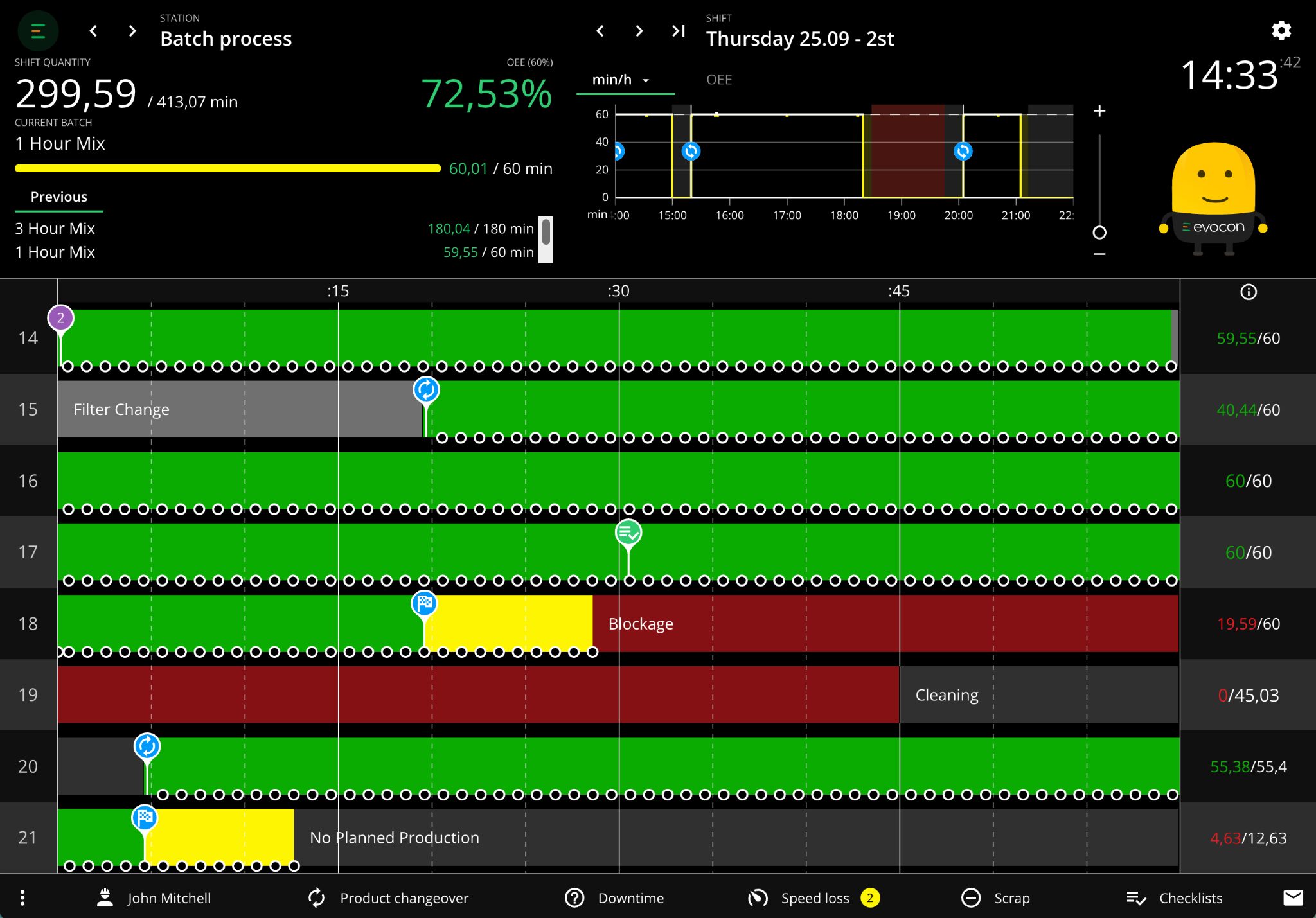
The production monitoring software records batch start and end times automatically. When you configure a batch station, the system shows:
- Automatic Targets
Pre-configured target times for each recipe step populate automatically during a changeover. - Real-time Status
The system flags exactly when a process step reaches its target, making it clear when a batch is running behind schedule. - Historical Comparison
You can compare the current batch duration against the “best ever” run to find opportunities for improvement.
Key Takeaways
Batch manufacturing requires a different OEE approach. Standard metrics built for discrete production will give you misleading numbers if applied without adjustment. The fundamentals of Availability, Performance, and Quality still apply, but each one needs to be adapted to the realities of recipe-driven, batch-by-batch production.
In the OEE formula, changeovers are recorded as Availability losses. However, the real opportunity for improvement lies in the excess time – anything beyond your standard target.
Every recipe step needs its own target. Performance is only meaningful when measured against the right benchmark. Using a single target speed for all recipes will either inflate or deflate your numbers.
Quality failures in batch production can lead to huge losses. A single failed batch can represent enormous material and time wasted.
Automation is the foundation of reliable OEE data. Manual logging introduces errors and gaps that undermine the value of your OEE efforts. Connecting OEE software directly to your equipment ensures the data you’re working with reflects what actually happened on the line in real time.


